The Trivium: The Liberal Arts of Logic, Grammar, and Rhetoric
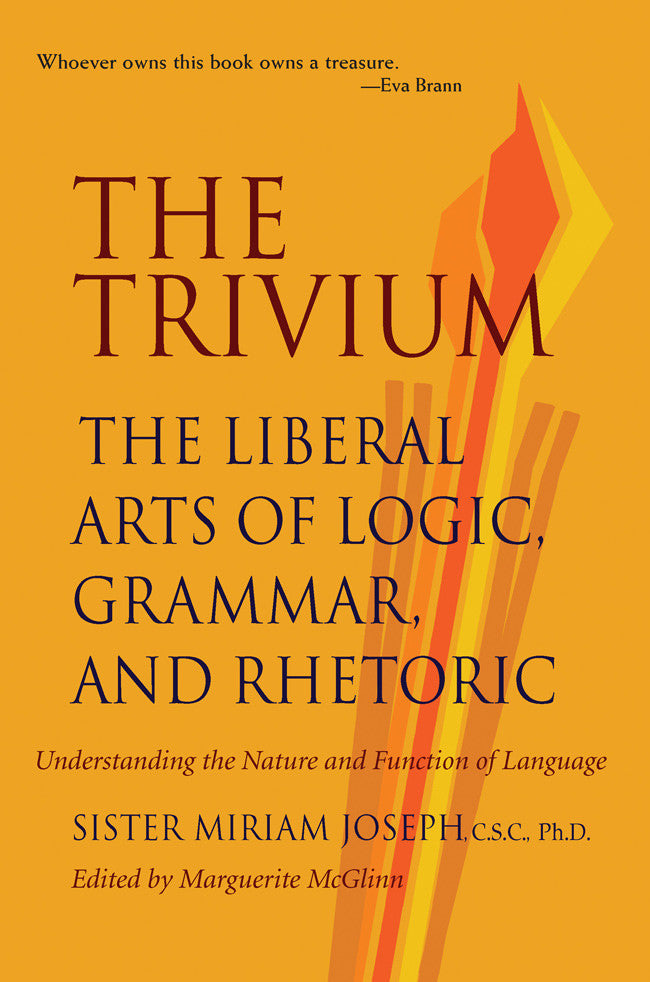
The Trivium: The Liberal Arts of Logic, Grammar, and Rhetoric
Sister Miriam Joseph
Couldn't load pickup availability
Edited by Marguerite McGlinn
292-page paperback / 6.13" x 9.25" / ISBN 9780967967509
Publication Date: May 2002
An essential book to develop mastery in reading, writing, speaking, and intellectual reasoning
In Plato’s Republic Socrates proposes a course of study that may be the original presentation of the idea of the “Liberal Arts.” These “arts” are divided into two groups of learning: the Quadrivium, (number, geometry, music, and astronomy) and the Trivium (logic, grammar, and rhetoric). The study of the Trivium develops mastery in reading, writing, speaking, and intellectual reasoning.
The Trivium is key to a classical education
“Trivium” means the crossroads where the three branches of language meet. In the Middle Ages and the Renaissance, students studied and mastered this integrated view of language. Regrettably, modern language teaching keeps the parts without the vision of the whole. In the 1940s, Sister Miriam Joseph at Saint Mary’s College rescued that integrated approach with The Trivium: The Liberal Arts of Logic, Grammar, and Rhetoric. The Paul Dry Books edition provides new graphics and notes to make the book accessible to today’s readers.
* The nature and function of language
* General grammar
* Logic and reasoning: propositions, syllogisms, and fallacies
* Induction and scientific method
* Rhetoric and communication: poetics, figurative language, metrical discourse
* Enlivened by examples: from Shakespeare, Milton, Plato, the Bible, Homer, and other great writers
A perfect book for teachers, students, writers, lawyers, and all serious users of language. The Trivium invites the reader into a deeper understanding, one that includes rules, definitions, and guidelines, but whose ultimate end is to transform the reader into a liberal artist.
"Is the trivium, then, a sufficient education for life? Properly taught, I believe that it should be."
—Dorothy L. Sayers
"The Trivium is a highly recommended and welcome contribution to any serious and dedicated writer's reference collection."
—Midwest Book Review
"Lovers of language who want to articulate its necessities and possibilities for themselves, teachers who want to explain its ways to their students, students who like the comfort of decisive clarity—all these will find this book a good companion, for Sister Miriam Joseph is one of those lovingly remembered teachers who arouses our critical abilities by offering us her firm but friendly learning. Her teaching is traditional. She fits language into the liberal arts, sets out the classical elements of grammar, explains Aristotelian logic, and gives solid advice on good writing, fleshing it all out with revealing examples."
—Eva Brann
"[I]f we want ourselves and our students to speak, write, and persuade others of reality at the highest level, The Trivium is perhaps the best available single-volume resource for such a task."
—Classical Ed Review
Also available as an ebook:
- Amazon
- Apple iTunes Bookstore
- Barnes & Noble
- Google Play
-
Kobo (See IndieBound's list of independent booksellers selling e-books.)
Looking for more on this topic?
Sister Miriam Joseph Rauh, C.S.C.
Marguerite McGlinn was an editor and writer whose essays and short stories appeared in English Journal, the New York Times, the Sun-Sentinel, the Philadelphia Inquirer, and the Los Angeles Times.
